Buying Your First Home in Dubai: Key Steps Every Buyer Should Know
When buying your first home in Dubai, it is not only about finding the right apartment or villa to buy and getting the financing right. The buying process includes DLD registration, funding limitations, developer approval, service fees, and other expenses related to the property. Knowing all these factors before placing your order will help avoid overspending or buying an unsuitable property.
Check Whether You Qualify as a First-Time Buyer
The first-time homebuyer scheme run by Dubai Land Department is one that should be considered before negotiations commence. Any citizen of the UAE, regardless of nationality, qualifies for the programme if he is at least 18 years old and is interested in buying a property for less than AED 5 million, and does not own a freehold residential property in Dubai at the time of registration.
Some of the benefits that eligible applicants will get include priority access to some property launches, special discounts on some off-plan properties, a flexible payment plan for the DLD registration fee via an eligible card, and special mortgage offers from participating banks. No fee is required to participate in the programme.
Before selecting a property, register through the Dubai Land Department’s Website or Dubai REST.
Calculate the Cash You Need, Not Just the Property Price
Suppose you are buying a ready apartment for AED 1.5 million.
A 4% DLD sale registration charge equals AED 60,000. DLD’s current sale registration service identifies the fee as 2% for the seller and 2% for the buyer, although the allocation can be agreed differently between the parties. The service also lists title deed, map and registration trustee charges.
If you finance the purchase, DLD’s mortgage registration fee is 0.25% of the mortgage value. So your budget should account for:
Down payment + DLD charges + mortgage registration + trustee and document charges + bank costs + immediate repairs or furnishing + cash reserve.
This is more useful than asking a bank only, “How much can I borrow?”
Get Financing Assessed Before You Make an Offer
When purchasing a property for the first time as an expatriate, according to CBUAE’s regulations, LTV for properties valued at less than AED 5 million can be up to 80%, while for properties worth more than AED 5 million, LTV can be up to 70%. The maximum mortgage tenure is 25 years, and the debt service ratio cannot be greater than 50%.
Thus, it does not necessarily mean that if the advertised price of the property is AED 2 million, the cash required will be only AED 400,000. Your cash requirement will also include other expenses and any shortfall arising from the valuation versus purchase price.
Compare Properties Using Ownership Cost
Two apartments with the same asking price can have very different ownership costs.
Before choosing between properties, compare:
- Annual service charges
- Parking arrangements
- Chiller or cooling costs
- Building age and maintenance condition
- Layout efficiency
- Floor and orientation
- Recent renovation requirements
- Access to your workplace and essential services
Service charges deserve particular attention because they continue after purchase. A lower purchase price does not necessarily mean a lower cost of ownership. For a home you intend to occupy, calculate the total monthly housing cost, includingmortgage, service charges, utilities and expected maintenance.
Inspect the Building as Carefully as the Apartment
A beautifully renovated apartment does not eliminate problems affecting the wider building. During the inspection, examine water leakage, air conditioning, plumbing, windows, electrical fittings, kitchen equipment and signs of repeated repairs. Then look beyond the front door. Check lifts, parking, corridors, common areas and building maintenance.
For resale properties, ask for relevant documents and verify the unit’s ownership and transaction status before paying a substantial amount.
Your objective is to identify expenses that are not obvious from the property’s asking price.
Understand How Dubai Registers the Purchase
For a completed property sale, DLD’s current process requires the buyer and seller to complete the registration through a Real Estate Registration Trustee centre. In freehold areas, the developer’s electronic NOC is among the required documents. DLD issues an electronic title deed after completion of the registration process.
If the purchase is financed, the mortgage must also be registered. DLD’s mortgage registration service currently charges 0.25% of the mortgage value. This makes the transaction more than a private agreement between buyer and seller. The lender, developer where applicable, trustee centre, and DLD all form part of the process.
Treat Off-Plan and Ready Properties Differently
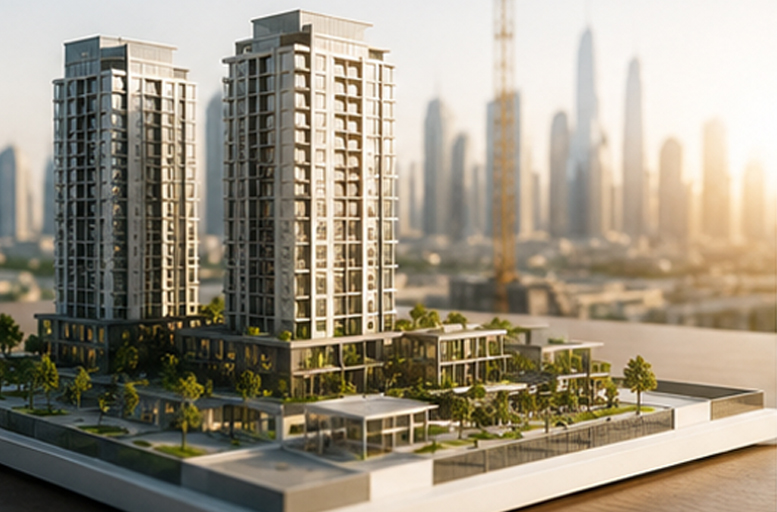
In case you are planning to buy off-plan property for the first time, don’t be mistaken into thinking that it follows similar financing guidelines.
As per CBUAE guidelines, there is a cap on the LTV ratio set at 50% for all off-plan properties irrespective of the purpose, value, or category of the property. This implies that buying off-plan property involves much more upfront money than that of ready property. One needs to check whether the project has been registered, escrow agreement is in place, the developer’s reputation, construction status, payment plan, and SPA.
Make the Property Pass a Five-Year Test
Your first home should work beyond the day you receive the keys.
Consider whether the location will remain practical if your workplace changes, whether the property suits your household as it grows and whether you could rent or sell it if your circumstances change. For example, a large apartment with an attractive price may not be the right choice if its service charges are high and comparable units compete heavily for tenants or buyers. Conversely, a smaller property in a location with strong everyday demand may provide greater flexibility.
Ask these questions before committing:
- Can I fund the down payment and transaction costs?
- Has the bank assessed my borrowing capacity?
- Have I checked the building’s recurring costs?
- Have I inspected the actual property?
- Have I verified the registration requirements?
- If it is off-plan, have I checked the project and financing structure?
- Would I still be comfortable owning this property five years from now?
Buying your first home in Dubai becomes far more manageable when the decision is based on verified costs, financing capacity, property condition and DLD procedures rather than the asking price alone. The strongest purchase is not necessarily the home with the most impressive amenities. It is the property whose total cost, financing structure, location and long-term suitability make sense for your circumstances.
To discuss your requirements with the best real estate broker in Dubai, call now at +971 4 329 8121.